Makeup air compliance is one of the most frequently misread variables in commercial kitchen ventilation specification. Whether a project requires tempered or untempered makeup air depends on state code, local jurisdiction, and in some cases the UL listing of the hood being installed. For resellers supporting installers and designers across multiple markets, understanding the compliance landscape by state is a prerequisite for accurate project scoping – here, the professionals at NAKS, Inc. break it down.
The Three Compliance Categories
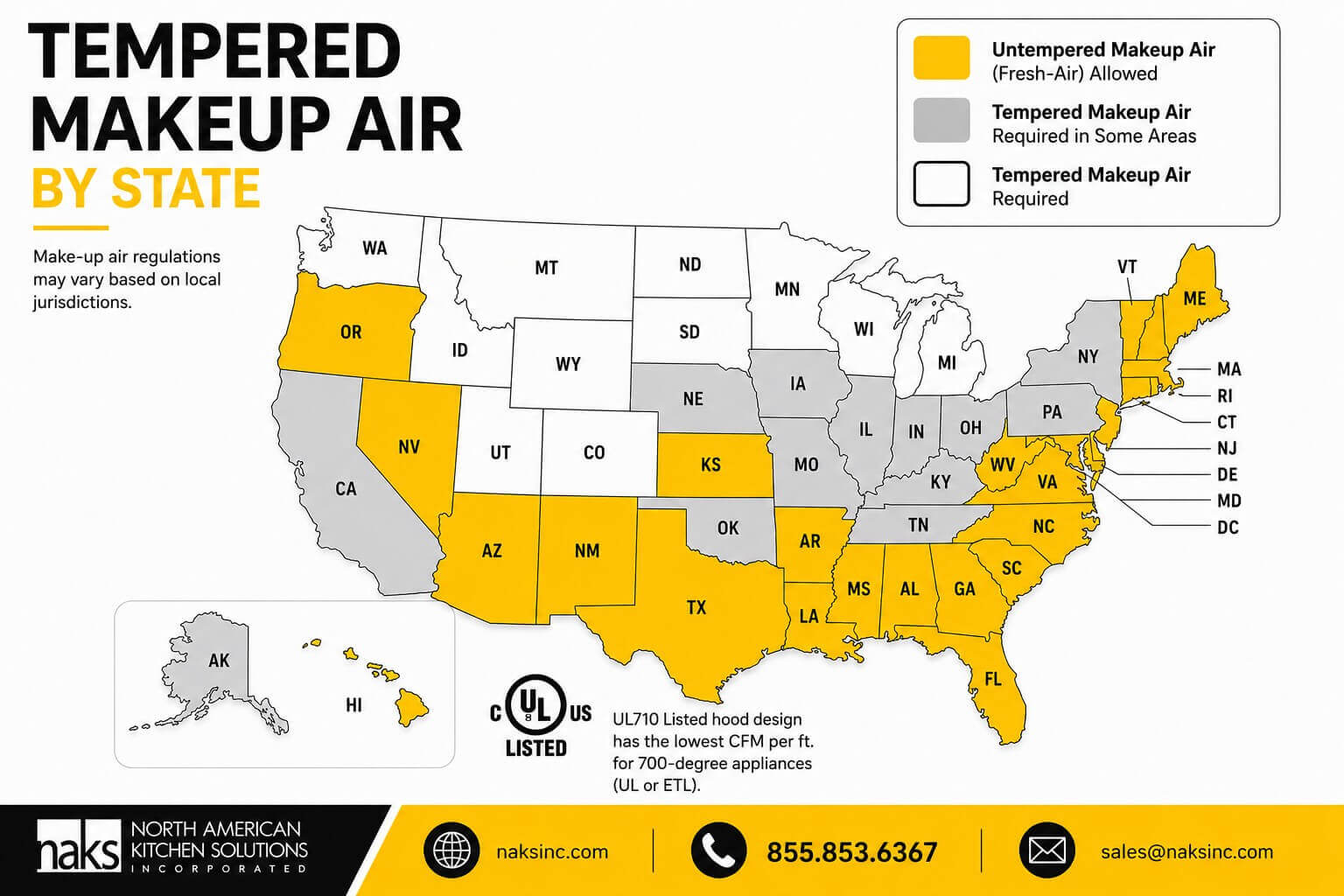
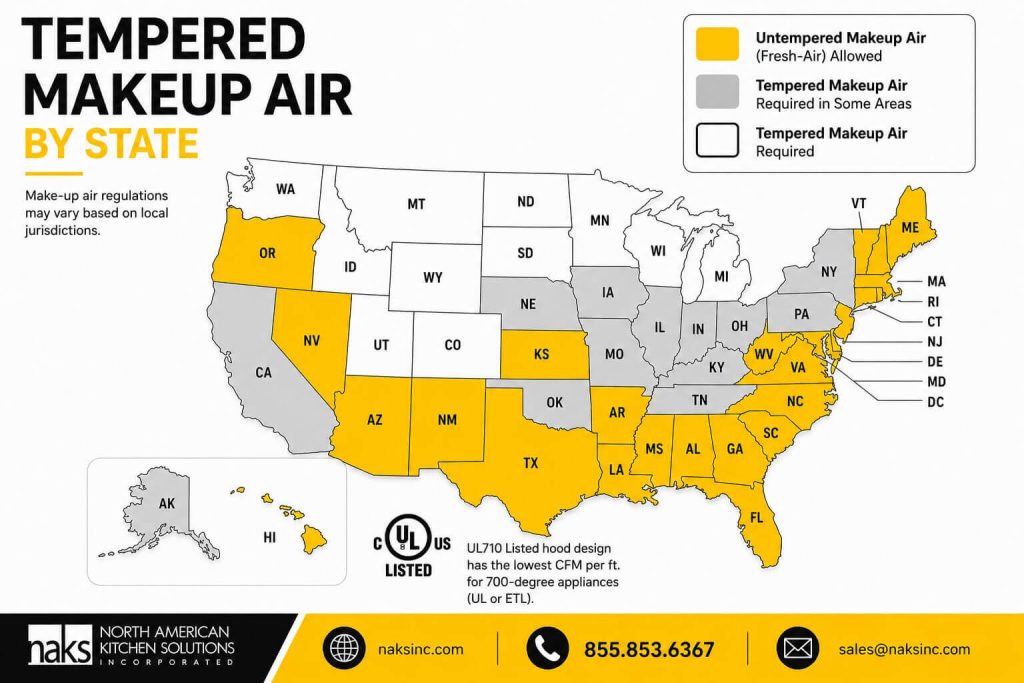
Makeup air regulations across U.S. jurisdictions fall into three distinct categories. Identifying which category applies to a given project is the first step in accurate makeup air specification.
- Untempered (fresh-air) makeup air permitted: no conditioning requirement on supply air
- Tempered makeup air required in some jurisdictions: local AHJ determines whether tempering applies
- Tempered makeup air required statewide: all commercial kitchen installations must supply conditioned makeup air
Local jurisdiction requirements can override state defaults in either direction. AHJ confirmation is mandatory before finalizing any makeup air specification.
Where Untempered Makeup Air Is Permitted
A significant portion of the southern and western U.S. permits untempered fresh-air makeup air supply for commercial kitchen ventilation installations.
- Includes states such as Texas, Florida, Georgia, Arkansas, Louisiana, Kansas, Arizona, New Mexico, Oregon, Nevada, and Hawaii, among others
- Untempered systems carry lower equipment cost and simpler installation requirements
- Climate conditions may make tempered supply preferable for operator comfort even where not required by code
- Local jurisdiction requirements must still be confirmed even in untempered-permitted states
Permitting untempered makeup air does not eliminate the obligation to deliver adequate CFM volume to balance the exhaust system.
Where Tempered Makeup Air Is Required
The majority of northern and mid-Atlantic states require tempered makeup air statewide or across most local jurisdictions.
- Includes states such as Montana, Wyoming, Colorado, Utah, Idaho, North Dakota, South Dakota, Nebraska, Minnesota, Wisconsin, Michigan, Indiana, Ohio, Pennsylvania, New York, Virginia, and others
- Tempered systems must supply air within a defined temperature range to prevent negative pressure and occupant discomfort
- System sizing must account for both heating and cooling loads in addition to CFM volume
- Tempering equipment adds cost and lead time that must be factored into project scheduling
States in mixed or transitional categories, including California, Illinois, Tennessee, and others, require jurisdiction-level confirmation before any makeup air specification is finalized.
How UL 710 Listing Reduces Makeup Air System Sizing
Hood UL listing has a direct impact on makeup air system sizing, particularly for high-temperature cooking equipment.
- UL 710 listed hood designs achieve the lowest CFM per foot for 700-degree appliances
- Lower CFM requirements reduce the size and cost of the makeup air unit required to balance the system
- Non-listed hoods require higher exhaust volumes, which increases makeup air equipment sizing proportionally
- Specifying a UL 710 listed hood produces measurable cost savings on the makeup air side of the project
For resellers advising clients on system cost, the relationship between hood listing and makeup air sizing is a meaningful value proposition worth communicating early in the specification process.
Specification Considerations for Multi-Market Resellers
Resellers supporting projects across multiple states or jurisdictions need a consistent approach to makeup air compliance that accounts for variable requirements without slowing down the specification process.
- Develop a standard project intake checklist that captures state and local jurisdiction makeup air category
- Maintain relationships with makeup air unit suppliers who offer both tempered and untempered product lines
- Document AHJ confirmation in project files for inspection and warranty purposes
- Build makeup air requirement review into early project scoping – not the submittal phase
A tempering requirement identified early is a line item. Identified late, it is a schedule and budget problem.
FAQ: Tempered Makeup Air Requirements
Who makes the final determination on whether tempered makeup air is required?
The authority having jurisdiction (AHJ) makes the final call. State code establishes the baseline, but local jurisdictions can impose stricter requirements.
Does a UL 710 listed hood reduce makeup air requirements?
Yes. UL 710 listed hood designs are certified to the lowest CFM per foot for 700-degree appliances, which reduces required makeup air volume and can reduce equipment sizing and cost.
Can untempered makeup air cause performance problems even where it is permitted?
Yes. In colder climates, untempered supply air can create negative pressure, thermal discomfort, and condensation issues on cooking equipment, even where it meets minimum code requirements.
How should resellers handle projects in states with mixed jurisdiction requirements?
Confirm with the local AHJ on every project regardless of state-level defaults. Mixed-category states require jurisdiction-level verification before any makeup air specification is finalized.
Makeup Air Specification Support from NAKS
NAKS supports resellers with product selection and technical guidance across all makeup air compliance categories and project types. Contact the NAKS, Inc. team today to get started.