Menu
Menu


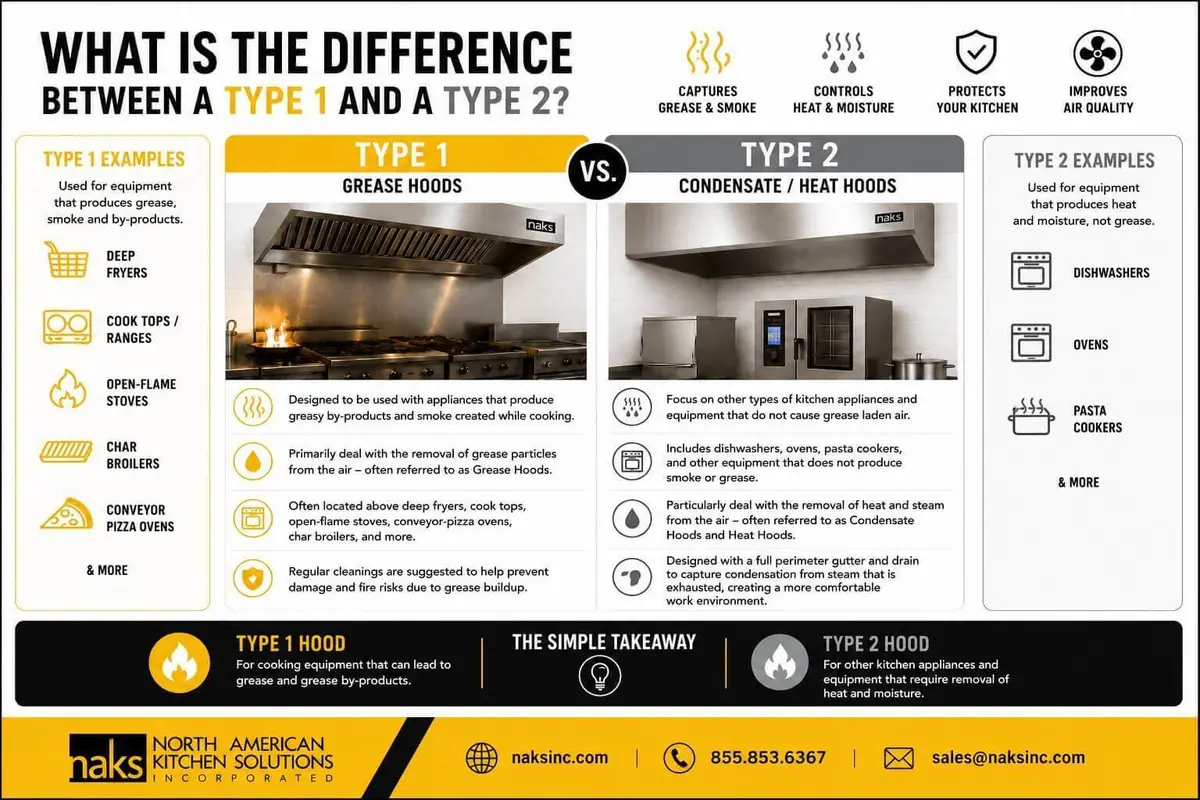
Discover the difference between Type 1 and Type 2 commercial kitchen exhaust hoods from the experts at NAKS, Inc.. The Different Types of Kitchen Hoods and Their Uses When it comes to maintaining a safe and clean professional kitchen environment, proper ventilation is essential. Kitchen hoods play a crucial role in removing smoke, odors, grease-laden…

The hanging ventless hood comes in two configurations, wall-mount and island, and picking the right one depends on more than which wall the equipment happens to sit near. Clearance dimensions, skirt sizing, and overall footprint shift between the two, and getting the configuration wrong at the quote stage tends to surface as a change order…

Misclassifying a hood at the estimating stage is one of the most expensive mistakes in commercial kitchen design, because it doesn’t surface until duct, fire suppression, and makeup air have already been ordered around the wrong assumption. Here’s how to get the classification right the first time, from the commercial kitchen ventilation experts at NAKS,…
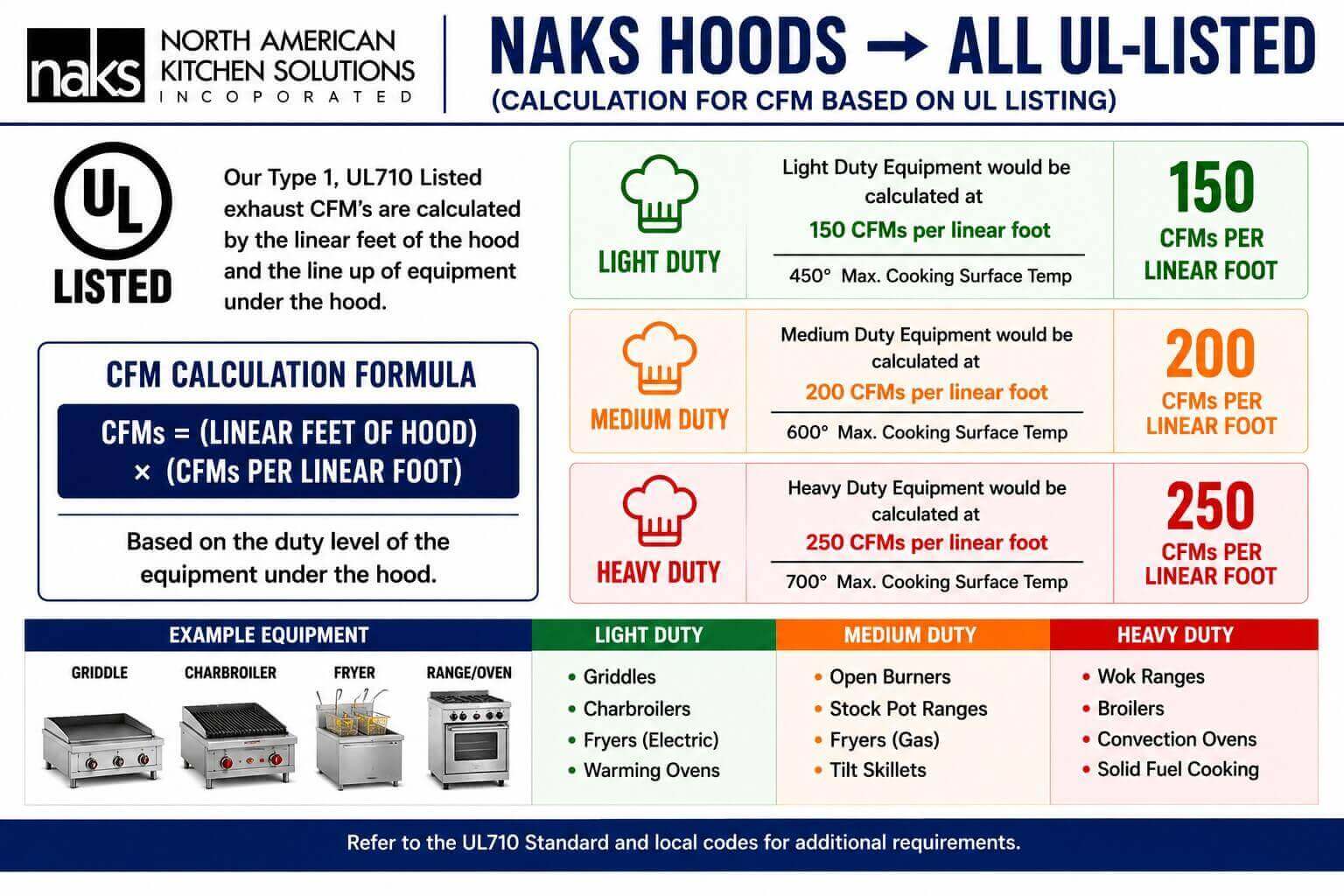
Equipment classification is the variable that resellers and installers most frequently get wrong at the specification stage, and it is the variable with the most direct impact on exhaust CFM, fan sizing, duct diameter, and makeup air volume. Under the UL 710 standard, every piece of cooking equipment beneath a Type 1 hood falls into…

Misclassifying a hood at the estimating stage is one of the most expensive mistakes in commercial kitchen design, because it doesn’t surface until duct, fire suppression, and makeup air have already been ordered around the wrong assumption. Here’s how to get the classification right the first time, from the commercial kitchen ventilation experts at NAKS,…

If you’re a fire protection contractor managing accounts across a dozen kitchens or a hundred, inspection tracking isn’t a favor you do clients. It’s the backbone of your service revenue and your liability protection. In this guide from NAKS, we break down what NFPA 96 actually requires and how to build a tracking system that…
For resellers and installers specifying commercial kitchen ventilation, CFM calculation is the foundational variable that drives every downstream decision — fan selection, duct sizing, and makeup air system design. NAKS, Inc. Type 1 exhaust hoods are all UL 710 listed, which enables a defined, reduced CFM calculation method based on hood linear footage and equipment…
Specifying the wrong hood type is one of the most consequential errors in a commercial kitchen design. Type 1 and Type 2 hoods are built for different exhaust loads, carry different construction and fire suppression requirements, and are not interchangeable. This post from the commercial kitchen ventilation experts at NAKS, Inc. covers the core differences,…

Understanding NFPA 96 standards isn’t optional—it’s essential for keeping commercial kitchens safe, compliant, and operational. Whether you’re a contractor, installer, or reseller, knowing the latest NFPA 96 requirements can help you avoid costly mistakes and protect your clients. Here’s what you need to know, straight from the experts at NAKS, Inc. What Is NFPA 96?…
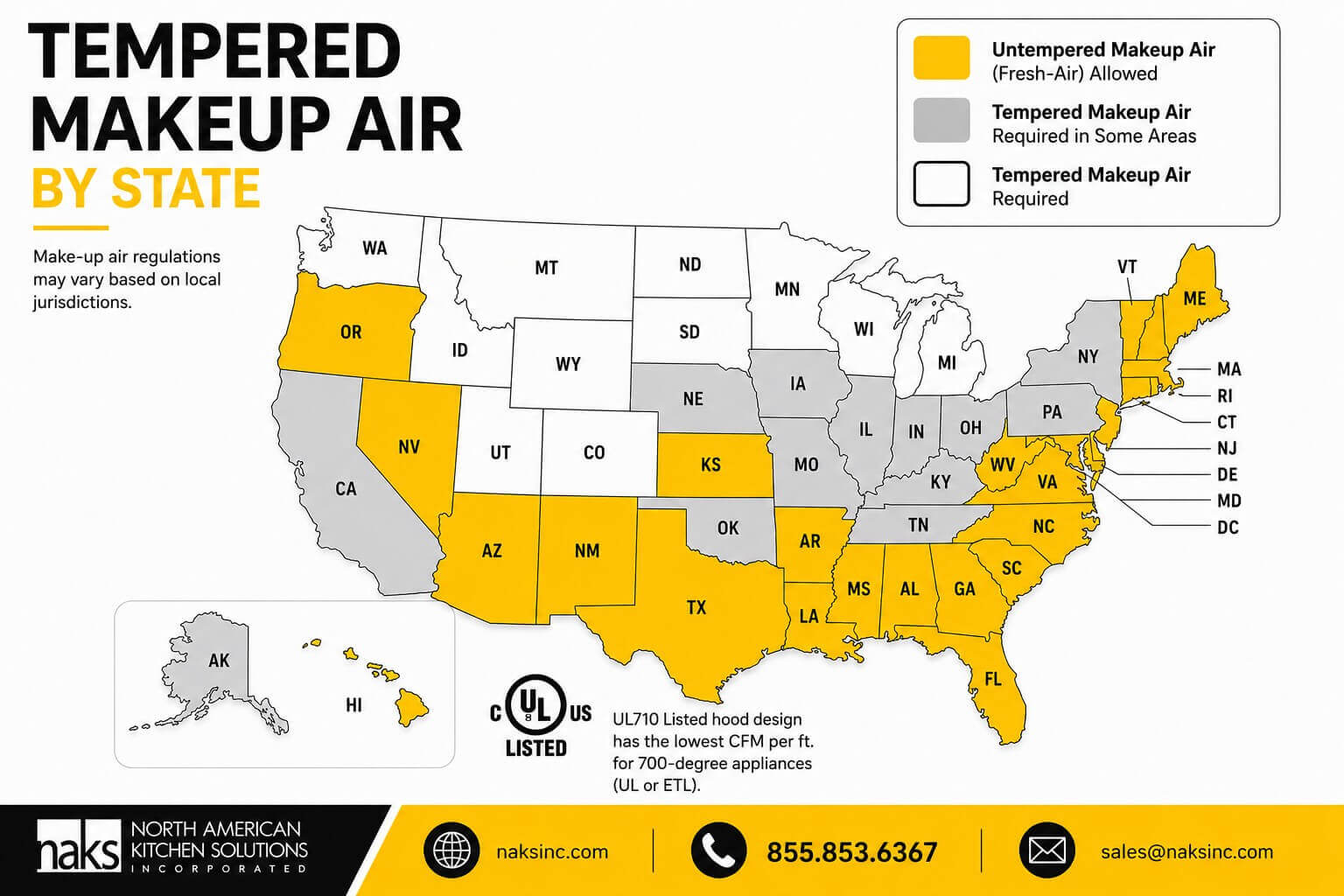
Makeup air compliance is one of the most frequently misread variables in commercial kitchen ventilation specification. Whether a project requires tempered or untempered makeup air depends on state code, local jurisdiction, and in some cases the UL listing of the hood being installed. For resellers supporting installers and designers across multiple markets, understanding the compliance…

Ductwork specification is where ventilation projects most frequently encounter field problems — wrong clearance assumptions, undersized diameters, and non-listed components that fail inspection. NAKS factory-built round grease duct is UL listed under UL1978 and UL2221, requires no field welding, and is available in configurations covering clearance-to-combustibles requirements from 18 inches down to zero. This guide…

Both Kidde and Ansul systems meet UL 300 requirements for commercial kitchen fire suppression. For resellers, installers, and kitchen designers, the meaningful differences are in nozzle configuration, pre-piping, detector compatibility, and jobsite installation time. This post from the commercial kitchen ventilation experts at NAKS, Inc. breaks down both systems at the specification level. UL 300…




 Call Us Now - 800-854-3267
 Text for Sales - 206-690-8429
Text for Support - 202-951-6748
Text for Sales - 206-690-8429
Text for Support - 202-951-6748
Text for Sales - 206-690-8429
Text for Support -202-951-6748
Text for Sales - 206-690-8429
Text for Support -202-951-6748
 | CAPTIVEAIRE | ECON-AIR | VENTILATION DIRECT | ACCUREX | LARKIN | |
|---|---|---|---|---|---|---|
| INDEPENDENT HOOD SAFETY CERTIFICATION LISTING |  |  | | |   | |
| INTEGRATED UL710 HOOD AND FAN SYSTEM | ||||||
| SHORT-CYCLE HOOD WITH INTERNAL MAKE-UP AIR PLENUM OFFERED | ||||||
| MORE EFFICIENT SHORT CYCLE MAKE-UP AIR UP TO 80% UNTEMPERED | N/A | N/A | N/A | N/A | ||
| OFFERS VENTLESS HOODS | ||||||
| CANOPY HOOD CFM PER FOOT EXHAUST AT 700F | 150 CFM/FT | 175 CFM/FT | 175 CFM/FT | 175 CFM/FT | 270 CFM/FT | 300 CFM/FT |
| Please Note: Independent safety certifications available in UL and ETL Listing directories. Integrated Hood and Fan System: Refers to a single preassembled unit. More Efficient Short Cycle Make-Up Air Hood Up To 80% Untempered: Based on data in UL Listing; not offered by CaptiveAire, Econ-Air, and Ventilation Direct; conclusive data unavailable for Larkin. Short-Cycle Hood With Internal Make-Up Air Plenum Offered and Offers Ventless Hoods: Per manufacturers’ websites. Hood CFM Per Foot Exhaust at 700° F: Based on UL 710 (700 deg F) testing of canopy hoods over standard equipment; data available in UL Listing, product label, or manufacturer website. |