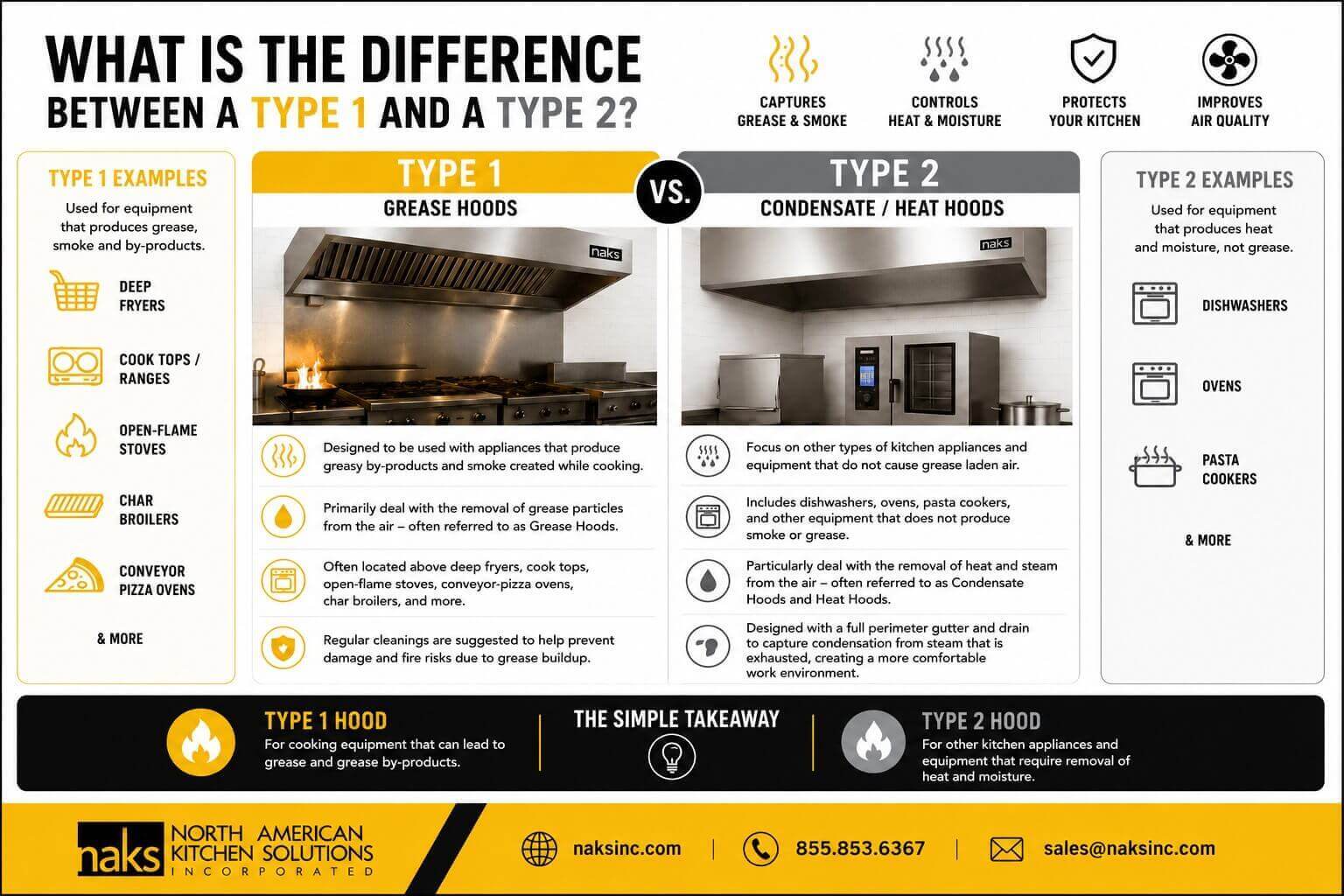
Specifying the wrong hood type is one of the most consequential errors in a commercial kitchen design. Type 1 and Type 2 hoods are built for different exhaust loads, carry different construction and fire suppression requirements, and are not interchangeable. This post from the commercial kitchen ventilation experts at NAKS, Inc. covers the core differences, appliance compatibility, and specification considerations for both.
What Defines a Type 1 Hood
Type 1 hoods are grease hoods. They are required above any cooking equipment that produces grease-laden vapors, smoke, or grease by-products during operation.
- Required above deep fryers, open-flame ranges, char broilers, griddles, and conveyor pizza ovens
- Must be constructed of a minimum 18-gauge steel or 20-gauge stainless steel per NFPA 96
- Required to include a listed grease filter system and grease collection components
- Fire suppression system installation is mandatory on all Type 1 hood applications
- Exhaust ductwork must be welded, liquid-tight, and constructed of steel per code
Type 1 hoods must meet UL 710 listing requirements for listed hood performance. Non-listed hoods require higher CFM to achieve equivalent capture performance.
What Defines a Type 2 Hood
Type 2 hoods are condensate and heat hoods. They are designed for equipment that produces heat, steam, and moisture, but not grease-laden air.
- Required above dishwashers, ovens, pasta cookers, steamers, and similar non-grease-producing equipment
- Constructed to handle condensate, heat, and steam removal without grease-rated components
- Full perimeter gutter and drain system captures condensation from steam exhaust
- Fire suppression is not required under Type 2 hoods (no grease-laden air present)
- Lower construction and material requirements compared to Type 1
Type 2 hoods cannot be substituted for Type 1 applications. If a cooking process produces any grease by-products, a Type 1 hood is required regardless of equipment classification.
Appliance Classification and Common Specification Errors
The most frequent error in hood type specification is misclassifying the equipment being served. Appliance classification drives hood type, not the other way around.
- Combination ovens that include open-element or gas-fired cooking may require Type 1, not Type 2
- Equipment manufacturers’ listings should be verified against the intended cooking application
- Equipment changes after installation can require hood reclassification and suppression system updates
- When equipment produces both grease and steam, default to Type 1 specification
If the appliance classification is ambiguous, consult the equipment manufacturer’s UL listing documentation before specifying the hood type.
Construction and Material Requirements
Type 1 and Type 2 hoods differ significantly in required construction standards. These differences affect fabrication, lead time, and installed cost.
Type 1 requirements:
- Minimum 18-gauge steel or 20-gauge stainless steel construction
- Welded, liquid-tight grease duct required
- Listed grease filters, grease cup, and collection channels required
- All seams must be continuously welded and grease-tight
Type 2 requirements:
- Lower gauge requirements acceptable in most jurisdictions
- Perimeter gutter and condensate drain required
- No grease filter or fire suppression requirement
- Ductwork specifications are less stringent than Type 1
Verify local code requirements, as some jurisdictions impose construction standards above the NFPA 96 minimum for both hood types.
Makeup Air and Exhaust Volume Considerations
Hood type affects not only suppression and construction requirements but also exhaust and makeup air system sizing.
- Type 1 hoods over high-challenge equipment (char broilers, solid fuel) require the highest exhaust volumes
- UL 710 listed Type 1 hoods achieve the lowest CFM per foot for 700-degree-rated appliances
- Type 2 applications generally require lower exhaust volumes due to the absence of grease-laden air
- Makeup air system sizing must be matched to the exhaust volume of the specified hood type
Exhaust and makeup air volumes should be calculated based on the hood listing, appliance BTU load, and local jurisdiction requirements, not estimated from general reference tables.
FAQ: Type 1 vs. Type 2 Hood Specification
Q: Can a Type 2 hood be installed above a gas range if the range is set to low heat?
A: No. Any open-flame or gas-fired cooking equipment that produces grease by-products requires a Type 1 hood regardless of operating
Specifying the wrong hood type is one of the most consequential errors in a commercial kitchen design. Type 1 and Type 2 hoods are built for different exhaust loads, carry different construction and fire suppression requirements, and are not interchangeable. This post from the commercial kitchen ventilation experts at NAKS, Inc. covers the core differences, appliance compatibility, and specification considerations for both.
What Defines a Type 1 Hood
Type 1 hoods are grease hoods. They are required above any cooking equipment that produces grease-laden vapors, smoke, or grease by-products during operation.
- Required above deep fryers, open-flame ranges, char broilers, griddles, and conveyor pizza ovens
- Must be constructed of a minimum 18-gauge steel or 20-gauge stainless steel per NFPA 96
- Required to include a listed grease filter system and grease collection components
- Fire suppression system installation is mandatory on all Type 1 hood applications
- Exhaust ductwork must be welded, liquid-tight, and constructed of steel per code
Type 1 hoods must meet UL 710 listing requirements for listed hood performance. Non-listed hoods require higher CFM to achieve equivalent capture performance.
What Defines a Type 2 Hood
Type 2 hoods are condensate and heat hoods. They are designed for equipment that produces heat, steam, and moisture, but not grease-laden air.
- Required above dishwashers, ovens, pasta cookers, steamers, and similar non-grease-producing equipment
- Constructed to handle condensate, heat, and steam removal without grease-rated components
- Full perimeter gutter and drain system captures condensation from steam exhaust
- Fire suppression is not required under Type 2 hoods (no grease-laden air present)
- Lower construction and material requirements compared to Type 1
Type 2 hoods cannot be substituted for Type 1 applications. If a cooking process produces any grease by-products, a Type 1 hood is required regardless of equipment classification.
Appliance Classification and Common Specification Errors
The most frequent error in hood type specification is misclassifying the equipment being served. Appliance classification drives hood type, not the other way around.
- Combination ovens that include open-element or gas-fired cooking may require Type 1, not Type 2
- Equipment manufacturers’ listings should be verified against the intended cooking application
- Equipment changes after installation can require hood reclassification and suppression system updates
- When equipment produces both grease and steam, default to Type 1 specification
If the appliance classification is ambiguous, consult the equipment manufacturer’s UL listing documentation before specifying the hood type.
Construction and Material Requirements
Type 1 and Type 2 hoods differ significantly in required construction standards. These differences affect fabrication, lead time, and installed cost.
Type 1 requirements:
- Minimum 18-gauge steel or 20-gauge stainless steel construction
- Welded, liquid-tight grease duct required
- Listed grease filters, grease cup, and collection channels required
- All seams must be continuously welded and grease-tight
Type 2 requirements:
- Lower gauge requirements acceptable in most jurisdictions
- Perimeter gutter and condensate drain required
- No grease filter or fire suppression requirement
- Ductwork specifications are less stringent than Type 1
Verify local code requirements, as some jurisdictions impose construction standards above the NFPA 96 minimum for both hood types.
Makeup Air and Exhaust Volume Considerations
Hood type affects not only suppression and construction requirements but also exhaust and makeup air system sizing.
- Type 1 hoods over high-challenge equipment (char broilers, solid fuel) require the highest exhaust volumes
- UL 710 listed Type 1 hoods achieve the lowest CFM per foot for 700-degree-rated appliances
- Type 2 applications generally require lower exhaust volumes due to the absence of grease-laden air
- Makeup air system sizing must be matched to the exhaust volume of the specified hood type
Exhaust and makeup air volumes should be calculated based on the hood listing, appliance BTU load, and local jurisdiction requirements, not estimated from general reference tables.
FAQ: Type 1 vs. Type 2 Hood Specification
Q: Can a Type 2 hood be installed above a gas range if the range is set to low heat?
A: No. Any open-flame or gas-fired cooking equipment that produces grease by-products requires a Type 1 hood regardless of operating temperature.
Q: Is fire suppression required under a Type 2 hood?
A: No. Fire suppression is only required under Type 1 hoods, where grease-laden vapors are present. Type 2 hoods handle heat and moisture only.
Q: What happens if cooking equipment is changed after a Type 2 hood is installed?
A: If new equipment produces grease-laden vapors, the hood must be reclassified as Type 1 and brought into compliance with Type 1 construction and suppression requirements.
Q: Do both Type 1 and Type 2 hoods require makeup air?
A: Yes. Both hood types require makeup air to replace exhausted air volume. The CFM requirement differs based on hood type, listing, and appliance load.
Spec Support from NAKS
Getting hood type right at the design phase prevents costly rework at inspection. NAKS works with installers, resellers, and kitchen designers to ensure the right product is specified from the start. Contact NAKS at 855.853.6367 or request a free quote today to get started.