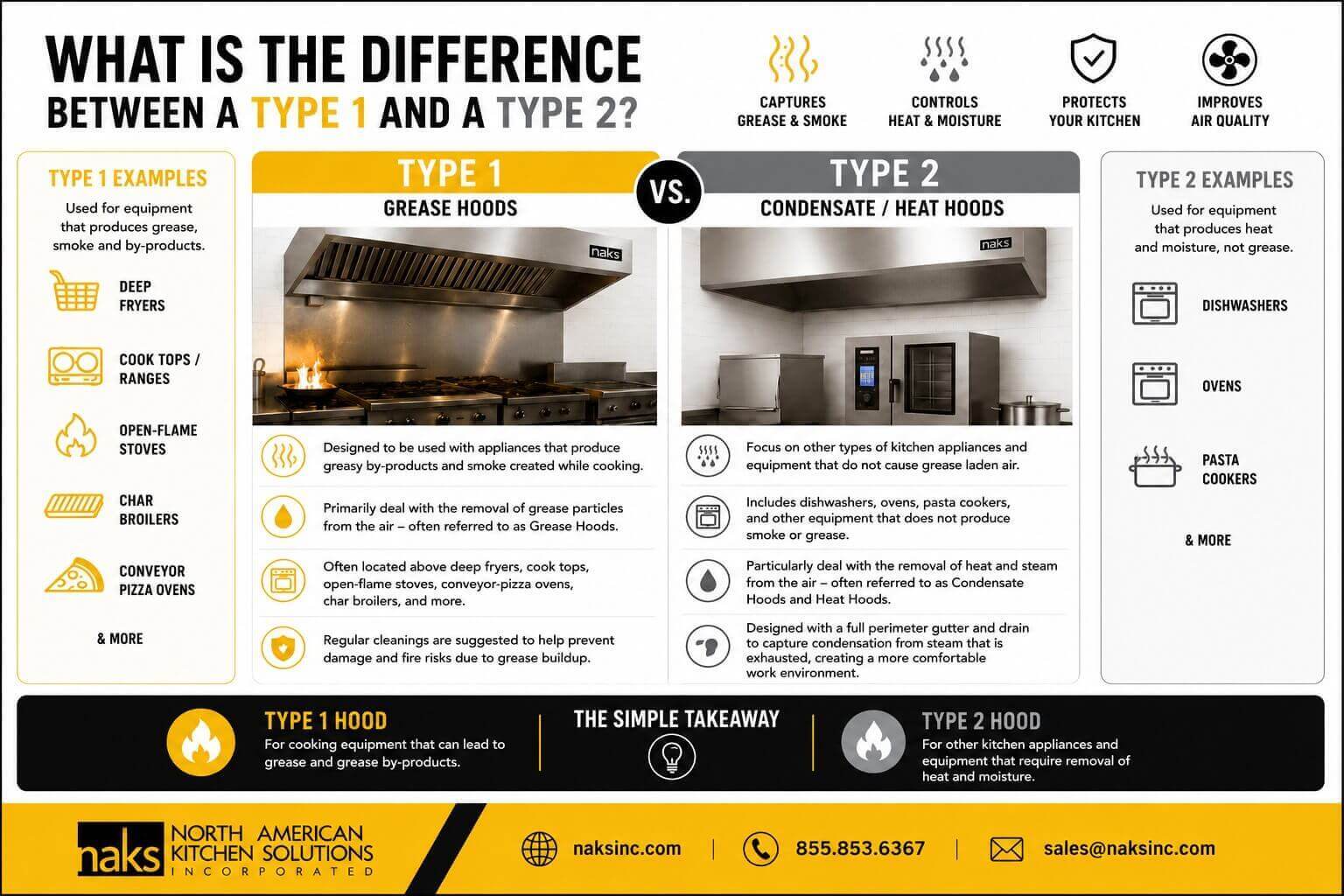
Misclassifying a hood at the estimating stage is one of the most expensive mistakes in commercial kitchen design, because it doesn’t surface until duct, fire suppression, and makeup air have already been ordered around the wrong assumption.
Here’s how to get the classification right the first time, from the commercial kitchen ventilation experts at NAKS, Inc..
What Actually Determines Classification
Hood classification is determined by what the appliance underneath it produces, not by the appliance category or kitchen type.
- Type 1 hoods are required over appliances that produce grease-laden vapors, including fryers, griddles, char-broilers, and ranges
- Type 2 hoods are required over appliances that produce heat, steam, or condensate without grease, including dishwashers, steam kettles, and some ovens
- The determining factor is the cooking process itself, not whether the appliance is gas, electric, or induction
- A single kitchen line frequently requires both classifications side by side, which is where estimating errors happen most often
Estimators working from equipment lists rather than appliance-by-appliance cooking process review are the most common source of misclassification.
Why the Distinction Cascades Through the Whole Project
Classification isn’t a standalone decision. It determines what else has to be specified correctly downstream.
- Type 1 hoods require grease duct construction, typically 16 gauge steel with continuous liquid-tight welded seams
- Type 2 hoods can generally use standard HVAC ductwork, since no grease is present to necessitate fire-rated construction
- Fire suppression systems are required over Type 1 hoods and generally not required over Type 2
- Makeup air calculations differ, since Type 1 systems typically move significantly more air than Type 2 condensate hoods
A hood misclassified at the estimating stage often means the wrong duct, the wrong fire suppression scope, and the wrong makeup air unit are all ordered together.
Common Misclassification Errors
A few scenarios account for most of the classification mistakes that surface during inspection.
- Combination ovens are sometimes treated as Type 2 by default, when many produce enough grease-laden vapor during certain cooking modes to require Type 1
- Induction equipment is occasionally assumed to be Type 2 since there’s no open flame, but classification depends on grease production, not heat source
- Steam kettles used for anything beyond boiling water can shift toward Type 1 depending on what’s being prepared
- Mixed-use lines with both fryers and steamers under a single hood run are sometimes specified as one classification when the code requires split coverage
When in doubt, classification should be based on manufacturer cooking process documentation, not visual assumption about the appliance.
What This Means for the Spec Sheet
A hood spec sheet built around classification, not just appliance dimensions, catches these issues before equipment is ordered.
- List the cooking process for each appliance alongside its physical spec, not just its footprint and BTU rating
- Flag any appliance with ambiguous grease output for manufacturer confirmation before finalizing classification
- Cross-check classification against duct, fire suppression, and makeup air scope before submitting for permit review
- Build in a review step with the installing contractor, since they’re often the ones who catch a misclassification the estimating team missed
Pro Tip: Classification determines the entire system architecture around a hood, and the cost of correcting a misclassification after installation is always higher than the time it takes to verify the cooking process at the estimating stage.
Type 1 v Type 2 Hoods: Frequently Asked Questions
Q: What determines whether a hood is Type 1 or Type 2?
A: The cooking process of the appliance underneath it. Type 1 covers grease-laden vapor production, while Type 2 covers heat, steam, or condensate without grease.
Q: Can a single kitchen line require both hood types?
A: Yes. Mixed equipment lines, such as fryers next to steam kettles, frequently require Type 1 coverage over some appliances and Type 2 over others.
Q: Do induction cooktops require Type 1 or Type 2 hoods?
A: It depends on grease production during cooking, not the heat source. Some induction applications still require Type 1 coverage.
Q: Is fire suppression required over Type 2 hoods?
A: Generally no, since Type 2 hoods are not installed over grease-producing appliances, but local code should always be confirmed.
Q: What’s the most common cause of hood misclassification?
A: Estimating from equipment dimensions and category rather than reviewing manufacturer documentation on actual cooking process and grease output.
Spec It Right the First Time
NAKS supports designers and estimators with hood classification guidance and the duct, fire suppression, and makeup air components to match, whatever the classification. Call 800-854-3267 or reach out for a quote today to review a spec before it goes to permit.