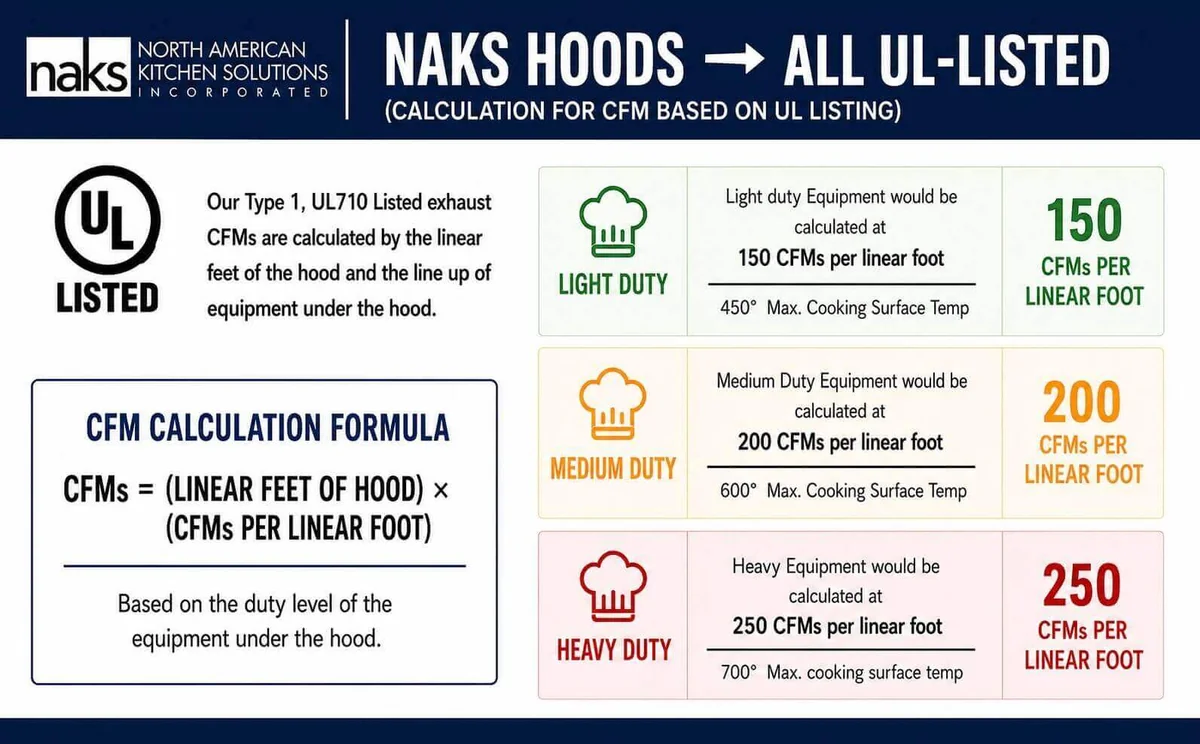
For resellers and installers specifying commercial kitchen ventilation, CFM calculation is the foundational variable that drives every downstream decision — fan selection, duct sizing, and makeup air system design. NAKS, Inc. Type 1 exhaust hoods are all UL 710 listed, which enables a defined, reduced CFM calculation method based on hood linear footage and equipment duty level.
What UL 710 Listing Means for CFM Calculation
UL 710 listing is what authorizes the use of the reduced CFM calculation method for Type 1 commercial kitchen exhaust hoods. Without it, exhaust rates default to higher values that increase equipment sizing and cost across the entire ventilation system.
- UL 710 listed hoods calculate CFM by multiplying hood linear footage by a defined CFM-per-linear-foot rate
- The CFM-per-linear-foot rate is determined by the duty level of the equipment beneath the hood
- Non-listed hoods require higher default CFM values, increasing fan, duct, and makeup air sizing
- ETL certification is an accepted equivalent to UL listing under the UL 710 standard
UL 710 listing is not an optional upgrade — it is the specification baseline that makes accurate, code-defensible CFM calculation possible.
The Three Duty Level Classifications
Equipment duty level is the variable that determines which CFM-per-linear-foot rate applies to a given installation. NAKS hoods are rated for all three duty levels under the UL 710 standard.
- Light-duty equipment (450-degree max cooking surface temp): 150 CFMs per linear foot
- Medium-duty equipment (600-degree max cooking surface temp): 200 CFMs per linear foot
- Heavy-duty equipment (700-degree max cooking surface temp): 250 CFMs per linear foot
Correctly classifying every piece of equipment in the lineup before calculating CFM is the most important step in a compliant, right-sized exhaust system specification.
How to Apply the CFM Calculation Formula
The UL 710 CFM calculation formula is straightforward: hood linear footage multiplied by the CFM-per-linear-foot rate for the applicable duty level.
- A 10-foot hood over medium-duty equipment calculates at 2,000 CFM (10 x 200)
- A 10-foot hood over heavy-duty equipment calculates at 2,500 CFM (10 x 250)
- Mixed equipment lineups should be calculated at the highest duty level present beneath the hood
- Hood linear footage must reflect the actual installed hood length, not the equipment footprint
Always refer to the UL 710 standard and local jurisdiction requirements for any conditions that may apply beyond the baseline calculation.
How CFM Calculation Affects Downstream Specification
An accurate CFM calculation at the design phase prevents oversizing and undersizing errors that create problems at every subsequent stage of the project.
- Duct diameter must be sized to handle the calculated CFM volume without creating airflow restriction
- Exhaust fan selection must match or exceed the calculated CFM at the required static pressure
- Makeup air system sizing is directly tied to exhaust CFM — the two volumes must be balanced
- An undersized exhaust system cannot maintain capture performance regardless of hood quality
Catching a CFM calculation error before equipment is ordered is a scheduling and budget issue. Catching it at inspection is a project failure.
FAQ: CFM Calculation for UL 710 Listed Hoods
Q: Can I use the UL 710 CFM calculation method with a non-listed hood?
A: No. The reduced CFM calculation rates are specific to UL 710 listed hood designs. Non-listed hoods require higher default exhaust volumes per local code.
Q: What happens if equipment under the hood changes after installation?
A: Any change to equipment type or duty level requires re-evaluation of the CFM calculation. A change from medium to heavy duty equipment, for example, increases the required CFM rate from 200 to 250 per linear foot.
Q: Does ETL certification qualify a hood for the UL 710 CFM calculation method?
A: Yes. ETL certification to the UL 710 standard is an accepted equivalent and qualifies the hood for the same reduced CFM calculation method.
Q: Who determines whether local jurisdiction requirements exceed the UL 710 baseline?
The authority having jurisdiction (AHJ) makes that determination. Always confirm local requirements before finalizing CFM calculations on any project.
CFM Calculation Support for Resellers and Installers
Accurate CFM calculation starts with the right hood specification. NAKS supports resellers and installers with product selection guidance and technical documentation across all duty level classifications and project types. Contact the commercial kitchen experts at NAKS, Inc. today to get started!