Both Kidde and Ansul systems meet UL 300 requirements for commercial kitchen fire suppression. For resellers, installers, and kitchen designers, the meaningful differences are in nozzle configuration, pre-piping, detector compatibility, and jobsite installation time.
This post from the commercial kitchen ventilation experts at NAKS, Inc. breaks down both systems at the specification level.
UL 300 Compliance: The Baseline for Both Systems
UL 300 is the governing standard for commercial cooking fire suppression in North America. Any system specified for a Type 1 hood installation must meet this standard.
- Both Kidde and Ansul are UL 300 listed
- NFPA 96 governs installation, inspection intervals, and post-discharge procedures
- Local AHJ requirements may add conditions beyond UL 300 minimums
- Semi-annual inspection and service is required on all listed systems
UL 300 compliance is the floor, not the ceiling. AHJ and local jurisdiction requirements should always be confirmed before final specification.
Kidde System Specifications
The Kidde APC (Automatic Pyro-Chem Commercial Cooking) system is engineered for precision knockdown and re-ignition suppression. Key technical differentiators include:
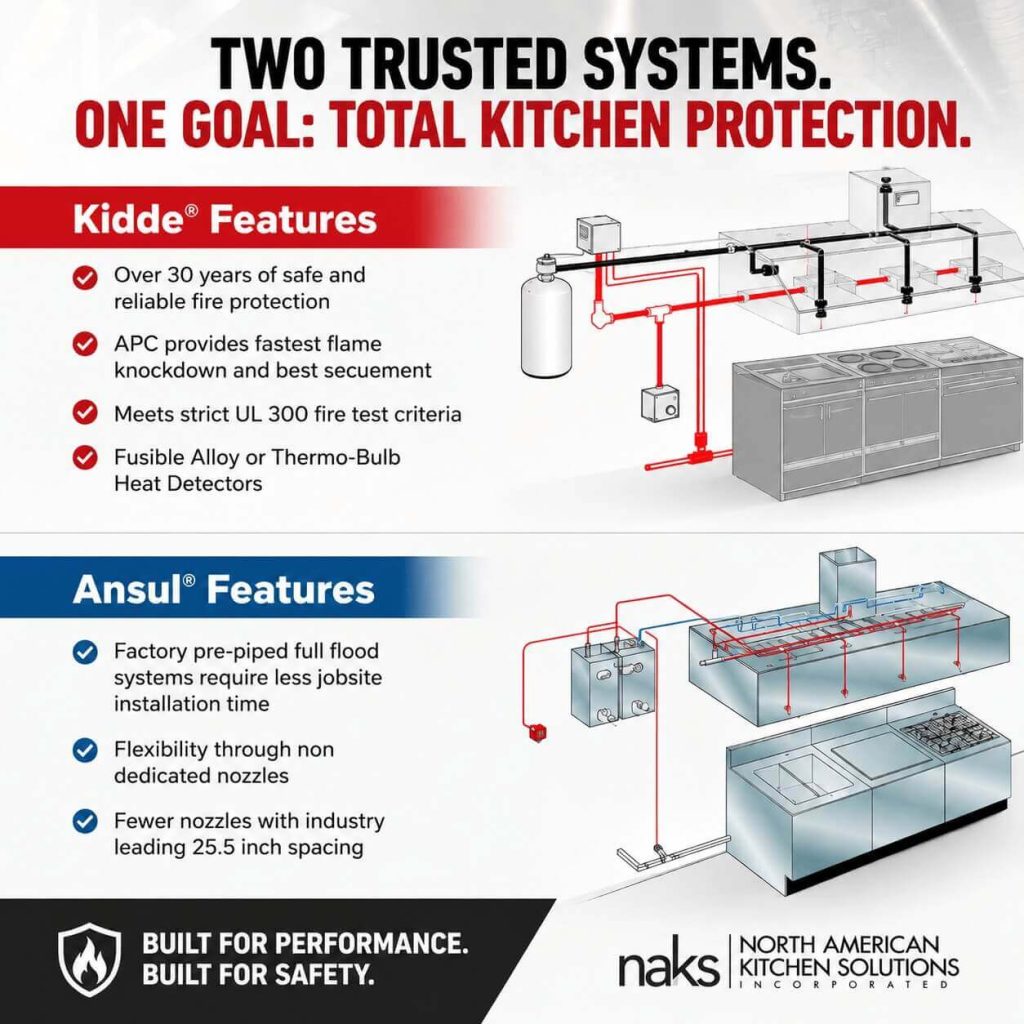
- APC agent chemistry provides industry-leading flame knockdown speed and securement
- Fusible alloy or thermo-bulb heat detectors available depending on application
- Meets UL 300 criteria for high-challenge cooking equipment including solid fuel appliances
- Straightforward piping layout makes it well-suited for single-appliance or linear equipment configurations
Kidde’s detector flexibility makes it adaptable to a wider range of equipment types and kitchen configurations without requiring system redesign.
Ansul System Specifications
Ansul’s R-102 and Piranha systems are designed with pre-piped, full-flood coverage and non-dedicated nozzle architecture. For installers, this translates to measurable time savings.
- Factory pre-piped full-flood systems arrive ready for faster jobsite connection
- Non-dedicated nozzles provide coverage flexibility across varied appliance footprints
- 25.5-inch nozzle spacing is the widest in the industry, reducing total nozzle count per installation
- Particularly effective for complex or multi-appliance hood configurations requiring adaptable coverage zones
Reduced nozzle count and pre-piped design directly reduce installation labor hours, which matters on commercial kitchen timelines.
Nozzle Configuration and Coverage Considerations
Nozzle selection and placement are the most consequential specification decisions in any suppression system design. Both systems handle this differently.
- Kidde uses dedicated nozzles tied to specific appliance types; placement is appliance-dependent
- Ansul’s non-dedicated nozzles can cover multiple appliance types without reconfiguration
- Coverage zone documentation must accompany every installation for inspection purposes
- Any change to cooking equipment after installation requires suppression system re-evaluation
Always verify that the suppression system specification matches the final equipment layout, not the preliminary design.
Installation and Jobsite Logistics
For installers coordinating with kitchen construction timelines, pre-piping and component count affect scheduling and labor estimates.
- Ansul’s factory pre-piped design reduces field assembly time
- Kidde installations require more field piping work but offer straightforward, predictable layouts
- Both systems require a licensed fire suppression contractor for installation and commissioning
- Post-installation inspection documentation must be provided to the operator and retained on-site
Factor suppression system installation into the critical path of any kitchen build-out schedule.
FAQ: Kidde and Ansul Suppression Systems
Q: Can Kidde and Ansul systems be used interchangeably on any Type 1 hood?
A: Both are compatible with Type 1 hoods, but the system must be specified and installed to match the exact cooking equipment layout. Interchangeability is not assumed.
Q: What is the difference between fusible alloy and thermo-bulb heat detectors?
A: Fusible alloy links melt at a set temperature to trigger discharge. Thermo-bulb detectors use a liquid-filled glass bulb that shatters at the rated temperature. Both are accepted under UL 300; selection depends on application and installer preference.
Q: Does changing cooking equipment require a suppression system update?
A: Yes. Any change to appliance type, position, or BTU output requires re-evaluation of nozzle placement and system coverage documentation.
Q: What does “non-dedicated nozzle” mean in the Ansul system?
A: Non-dedicated nozzles are not assigned to a single appliance type. A single nozzle can provide coverage for multiple equipment categories, which reduces total nozzle count and simplifies layout for complex configurations.
Q: Are post-discharge inspections required before the kitchen can reopen?
A: Yes. After any system discharge, a licensed contractor must recharge the system and certify it before the kitchen returns to service. Local fire marshals may also require a re-inspection.
Specify with Confidence
NAKS carries both Kidde and Ansul systems and supports resellers, installers, and kitchen designers through the specification and procurement process. Contact NAKS at 1.855.853.6367 or request a free quote today for system selection support and volume pricing.