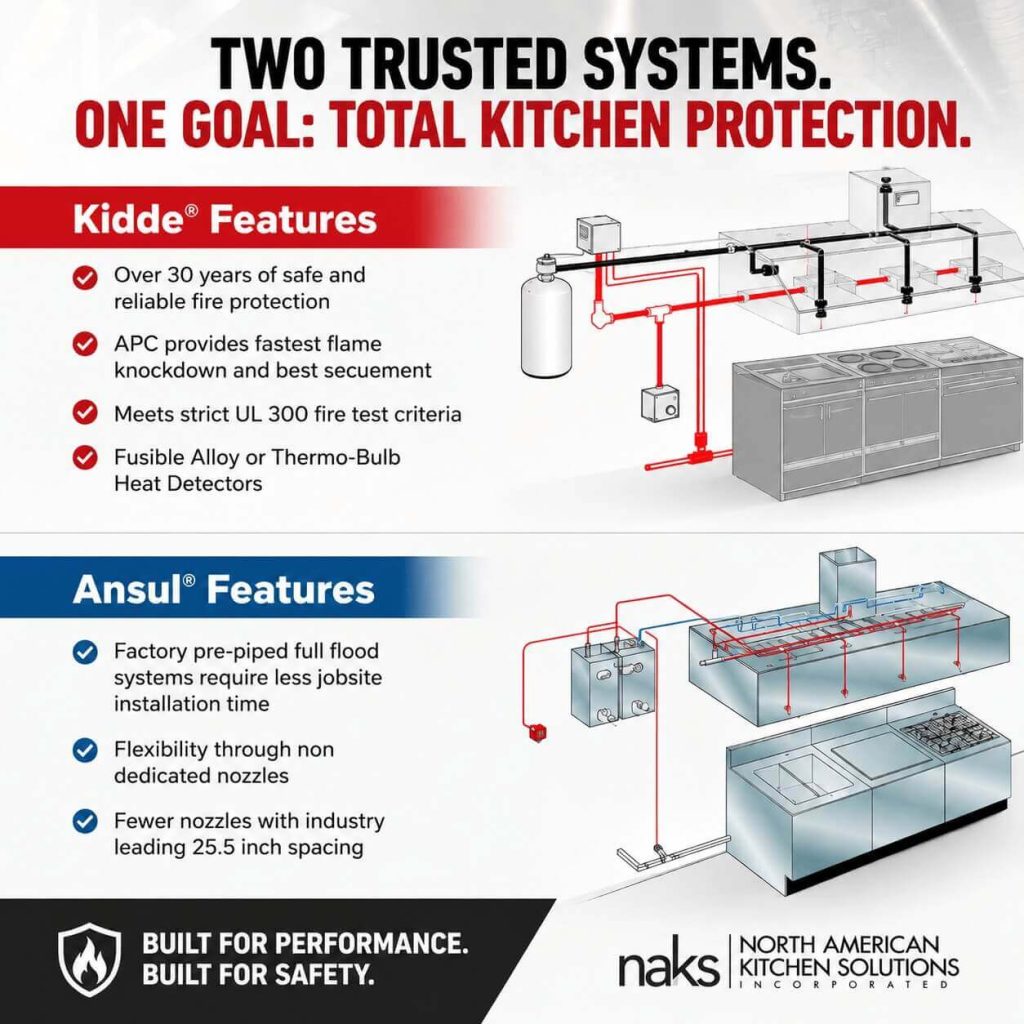
If you’re a fire protection contractor managing accounts across a dozen kitchens or a hundred, inspection tracking isn’t a favor you do clients. It’s the backbone of your service revenue and your liability protection. In this guide from NAKS, we break down what NFPA 96 actually requires and how to build a tracking system that doesn’t rely on memory alone.
The Semi-Annual Baseline for Fire Inspection
NFPA 96 requires fire suppression system inspection at minimum every six months. This applies regardless of kitchen size, cooking volume, or how clean the hood looks on a given day.
- Inspection must be performed by a certified fire suppression technician, not general kitchen staff
- Local jurisdictions can require more frequent inspection based on cooking volume or fuel type
- Insurance carriers often require proof of current inspection for policy renewal, independent of code minimums
- Missed inspection windows can void coverage even if no incident has occurred
Contractors who track only the code minimum are often surprised by insurer-driven requirements that arrive later in the relationship.
What Gets Checked at Each Visit
A compliant inspection isn’t a visual walkthrough. It’s a documented check of every component in the system.
- Nozzles are inspected for grease blockage, corrosion, and proper alignment over each protected appliance
- Detection links and fusible elements are checked for temperature rating accuracy and physical integrity
- The manual pull station is tested for accessibility and function
- Agent tanks are weighed or gauged to confirm proper charge
- Automatic fuel and electrical shutoffs are tested to confirm they trigger on system activation
Any deficiency found during inspection needs documentation and a remediation timeline, not just a verbal note to the operator.
Building a Tracking System That Scales
The contractors who lose accounts over inspection lapses are rarely acting in bad faith. They’re relying on a mental list instead of a system.
- Tag every account with its last inspection date and next due date at the point of service
- Build in a buffer of two to three weeks ahead of the six month mark, since scheduling conflicts are inevitable
- Flag accounts with high cooking volume or solid fuel appliances for a shorter internal cycle, even if code allows six months
- Keep inspection records accessible for insurance audits, not just filed away
A missed inspection costs more than a service call. It costs the account.
Fire Suppression Inspection: Frequently Asked Questions
Q: How often does NFPA 96 require fire suppression system inspection?
A: At minimum every six months, though local jurisdictions and insurance carriers can require shorter intervals.
Q: Who is qualified to perform a fire suppression inspection?
A: A certified fire suppression technician, not general kitchen or maintenance staff.
Q: What happens if an inspection is missed?
A: The system may be considered non-compliant, and insurance coverage can be affected even without an incident occurring.
Q: Do solid fuel cooking appliances change the inspection schedule?
A: Many contractors apply a shorter internal cycle for solid fuel or high volume kitchens, even when code allows the standard six month interval.
Q: What should be documented at each inspection?
A: Nozzle condition, detection link integrity, pull station function, agent tank charge, and confirmation that automatic shutoffs trigger properly.
The Practical Takeaway for Fire Protection Contractors: Stock the Parts Before the Inspection Finds the Problem
Six months is the floor, not the ceiling, and the contractors who build tracking systems around insurer requirements and appliance risk profiles protect both their clients and their business. Every inspection is also a touchpoint, not just a compliance checkbox. Operators who see you twice a year are far more likely to call you first when a nozzle needs replacing or a hood needs service work outside the inspection cycle. Treat inspection as a standalone obligation instead of a relationship anchor, and that revenue goes to a more organized competitor.
NAKS supplies the fire suppression components resellers and contractors need to keep every account inspection-ready, from nozzles to detection links to agent cylinders. Call 800-854-3267 or request a quote to talk through your parts inventory before your next inspection cycle.